

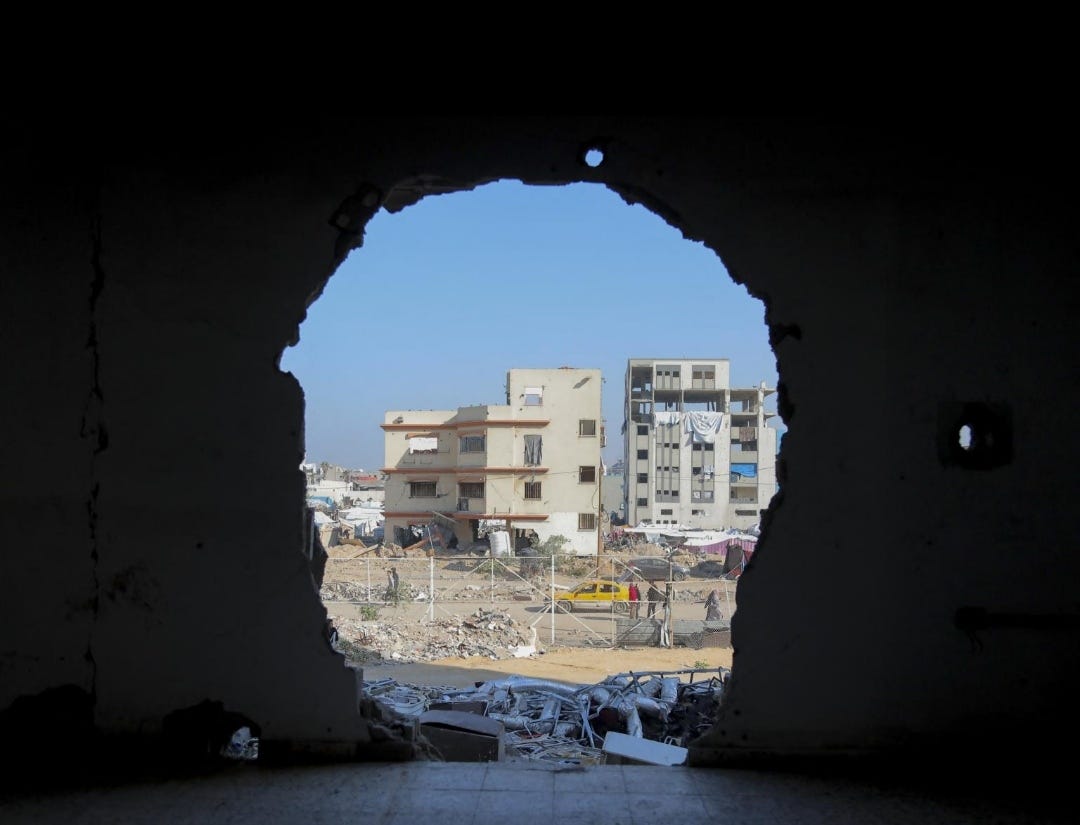
After every war, we are told: Now it is time to heal. The sentence is said simply, as if what happened were a passing storm, as if a human being could fold away two years or more of fear the moment the bombing disappears from the news.
As a psychological counselor, and as a woman who lived through genocide day by day inside Gaza, I know that healing does not begin this way. It does not come this quickly, and it cannot be imposed by decision. A few days of silence cannot erase years of terror. The absence of rockets does not return a sense of safety to the body.
We Are Not Healing We Are Trying to Continue
As a psychological counselor from Gaza, I say this calmly and honestly: We are not in a phase of healing. We are in a phase of trying to survive with the least possible psychological damage.
We try to sleep despite memory, to eat without panic about tomorrow, to reassure our children while we ourselves have not yet felt safe. Healing may come one day. But not now. Not this quickly. Not under these conditions.
Genocide is not erased by short periods of quiet. Healing does not begin until the pain truly stops, not just in the media.
How Is a Survivor Expected to Heal?
In Gaza, we are not asking for miracles. We are not searching for a rapid recovery that comforts the world and closes the file. We are simply trying to remain standing between a heavy memory and bodies that have not yet relearned what safety feels like. We are trying to live, not to convince others that we are fine.
But the question that must be asked honestly is: How can a people be asked to heal while they are still being pulled from under the rubble?
Those Who Emerged From Under the Rubble Do Not Heal Quickly
Those who were pulled from beneath the rubble cannot heal quickly. They cannot forget what it felt like to be unable to breathe, how scarce the air was, and how every breath felt like it might be the last. They cannot forget that beside them lay the body of their mother, or their father, or one of their siblings.
They cannot heal from the sound of the missile that tore through their home, nor from the moment when a place of safety became a trap of death. This kind of trauma does not fade with time alone, and it does not settle simply because survival was achieved. A body that learned how to hold its breath in fear, a mind that hovered for minutes between life and death, does not return to what it once was.
Genocide Does Not End When the Bombing Stops
What we endured was not a single event, but a prolonged experience of loss, hunger, forced displacement, and the collapse of everything that once gave life meaning.
Psychologically speaking, genocide is not limited to the sound of explosions. It is what remains inside a person afterward. It leaves behind a body locked in constant alert, a mind that anticipates danger even in silence, and a heart exhausted by repeated loss. Many believe that physical survival equals psychological survival. But the truth is that most survivors leave war carrying it within them: in trembling hands, in racing heartbeats, in sleepless nights, and in the persistent feeling that danger has not truly ended.
Repeated Loss Changes Us Forever
In genocide, loss is not a single event that passes. It is a continuous series of disappearances. You lose people. You lose homes. You lose your sense of the future. You lose the version of yourself you once were.
As a psychological counselor, I know that repeated grief is rarely fully processed. It is postponed, and it accumulates inside. That is why, after war, we often see: emotional numbness, sudden crying spells, unexplained anger, persistent exhaustion, and a constant sense of heaviness. These are not signs of weakness. They are natural responses to an unnatural experience.
Hunger and Displacement Are Not Minor Details
When a person spends months asking, "Will I find food today?", the brain learns survival, not life. Hunger does not harm the body alone; it fractures dignity and the sense of safety.
Displacement, meanwhile, is a profound psychological uprooting. To be forced to leave your home, your memories, your shelter is to have your sense of stability torn away and replaced with a constant feeling that everything is temporary, that everything can be lost again at any moment. This kind of trauma does not disappear with the end of war or a return to destroyed places.
Healing Is Not a Personal Decision
We cannot tell survivors: Move on. Healing is not a button to be pressed, nor a fixed timeline, nor an individual responsibility alone.
True healing requires: ongoing safety, material stability, honest acknowledgment of what happened, and humane space for grief and recovery. In Gaza, these conditions are still absent. The danger has not fully ended. Fear has not left. Loss remains present in every detail of daily life.
Follow me on: @shaza_rataj_gaza on Instagram.